
My Honest Review
Areas of Athens Where to Stay Highlights of Athens Getting around Athens My Honest Review
I spent one month travelling around Athens and surrounds, and at first I found Athens very overwhelming as there was just so much to do and see.
So, my hope for this is to help you get a better understanding of the history of this amazing city, the main areas of Athens that you’ll want to visit as well as the main attractions and sites, and how to navigate Athens.
Honestly, this is just a guide I wish I found before arriving in Athens – so I hope it helps you.
My advice for you in Athens is to put on a comfy pair of shoes and get lost in the ancient beauty and history that Athens has to offer. Walk up to the Acropolis, look over the city from the hill, and then come back down and wander the vibrant bustling streets of Plaka, Monastiraki and Syntagma. As you wander through these neighbourhoods – glance upon the unique facades of old and new, admire local arts and crafts, stop and taste the traditional flavours and enjoy the sound of traditional music and local chatter – after all, that is what travel is all about – enjoying the new sights, sounds, and tastes of a new area for the very first time.
I’m going to dive into a very brief history of Athens, as it’s so important for understanding the many historical and archaeological sites around Athens. I also always like knowing the history of places I travel so I can honour and respect the land, culture and people that formed the area that I am exploring and enjoying. Be a traveller, not a tourist. Respect the land, respect the culture and respect the history.
A brief history of Athens:
Named after Athena, the goddess of Wisdom and Strategic Warfare, Athens has a rich and captivating history that spans thousands of years.
Athens started as a small Mycenaean settlement on the Acropolis hill, but would soon grow to become the birthplace of democracy and a flourishing center of philosophy and the arts. Because of this, Athens has left a significant mark on the world, and is a must-visit destination for those seeking to explore the roots of Western civilization.
In the 6th century BCE, Cleisthenes introduced democratic reforms, allowing the citizens to participate in the decision-making process. This groundbreaking system laid the foundation for modern democratic governments that we have today.
Athens also witnessed remarkable achievements in the field of philosophy. The famous philosopher, Socrates, along with his students, Plato and Aristotle, developed profound ideas that influenced Western philosophy for centuries. Their emphasis on reason, ethics, and knowledge shaped the intellectual landscape of Athens.
But Athens also faced its fair share of challenges as it was involved in numerous wars, including the legendary conflict with Sparta known as the Peloponnesian War, which weakened both cities and led to Athens’ eventual decline. In subsequent centuries, Athens fell under the rule of various empires, including the Macedonians, Romans, and Byzantines.
But today, Athens stands as a bustling metropolis, blending its ancient heritage with modern day. The city showcases a multitude of archaeological sites, such as the Acropolis, the Ancient Agora, and the Temple of Olympian Zeus, and holds an extraordinary historical significance as the birthplace of democracy and a beacon of intellectual and artistic achievement. Its contributions in philosophy, architecture, and governance continue to resonate in society today.
Areas of Athens:
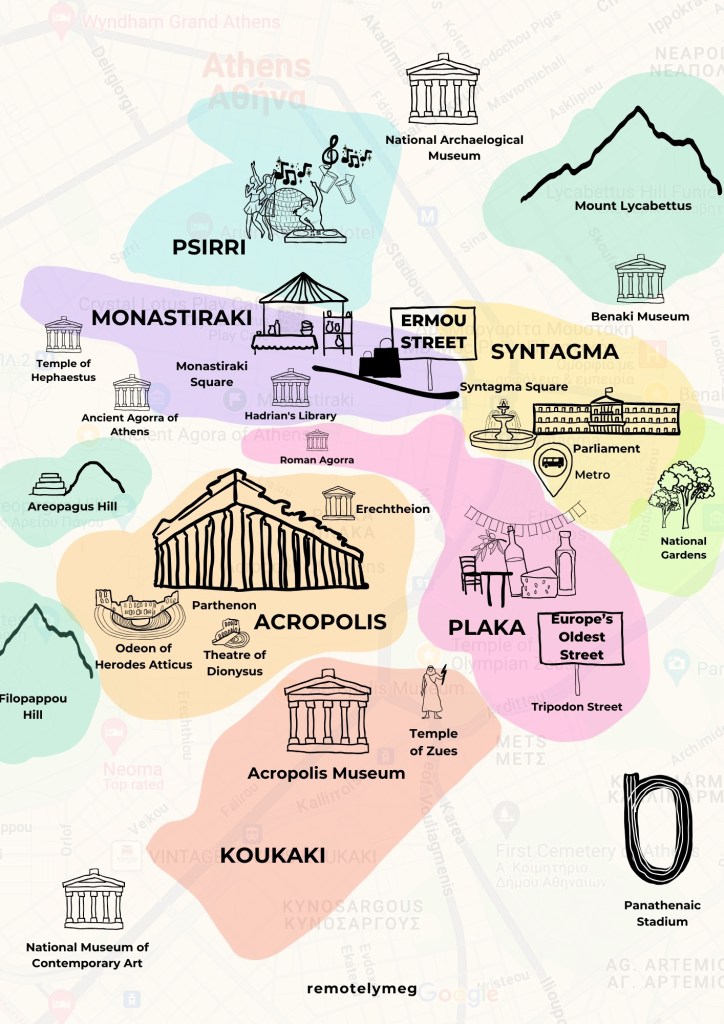
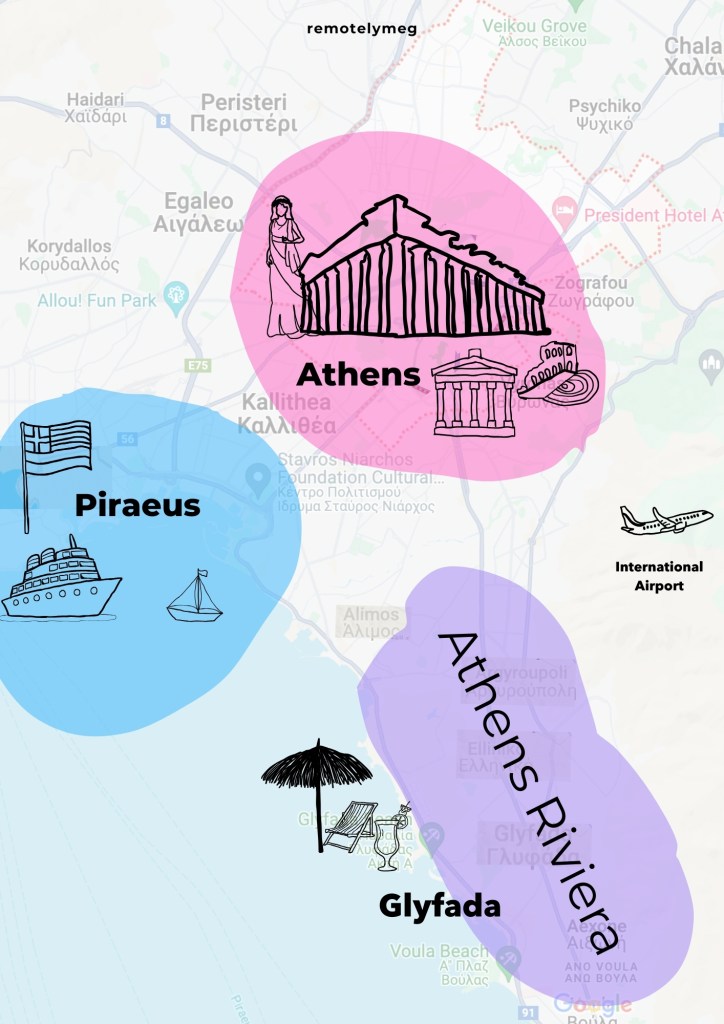
These are the main areas you need to know about:
- The Acropolis
- Plaka
- Monastiraki
- Syntagma
- Psirri
Then surrounding those, you’ll find:
- Kolonaki
- Colonus
- Gazi
Just outside of Athens, but still important are:
- Piraeus
- Athens Riviera
Areas explained:
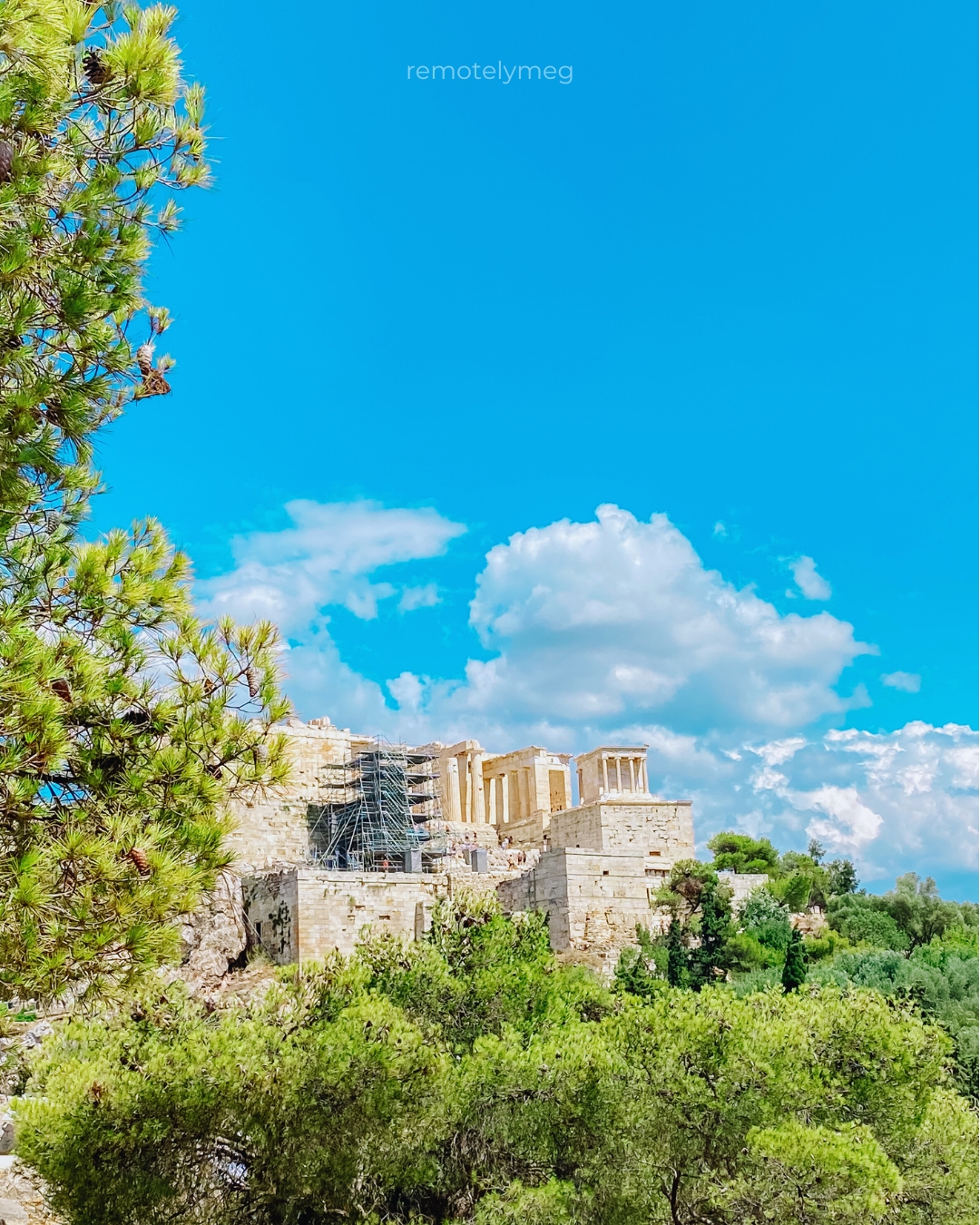
The magnificent Acropolis, which was built in the 5th century BCE, during the ‘Golden Age of Athens’, stands above the city center on a rocky outcrop, making it a key feature and honestly, hard to miss, when you are wandering the streets of Athens beneath it. It houses several ancient archaeological sites, including the iconic Parthenon, Erechtheion, and the Temple of Athena Nike which are main attractions and ‘must-sees’ during your time in Athens.
Then below the Acropolis, in a semi-circle loop, you get the areas of Plaka, Monistraki, Syntagma and Psirri. This loop below the Acropolis of these four areas were my favourite parts of Athens to explore, and I could have spent many more days getting lost in each of these neighbourhoods.
They are all bustling areas with their own unique charm and attractions. From vibrant markets, traditional tavernas, trendy bars, neoclassical buildings, famous ruins and well preserved historical monuments – these neighbourhoods are the perfect blend of ancient and modern-day Athens.
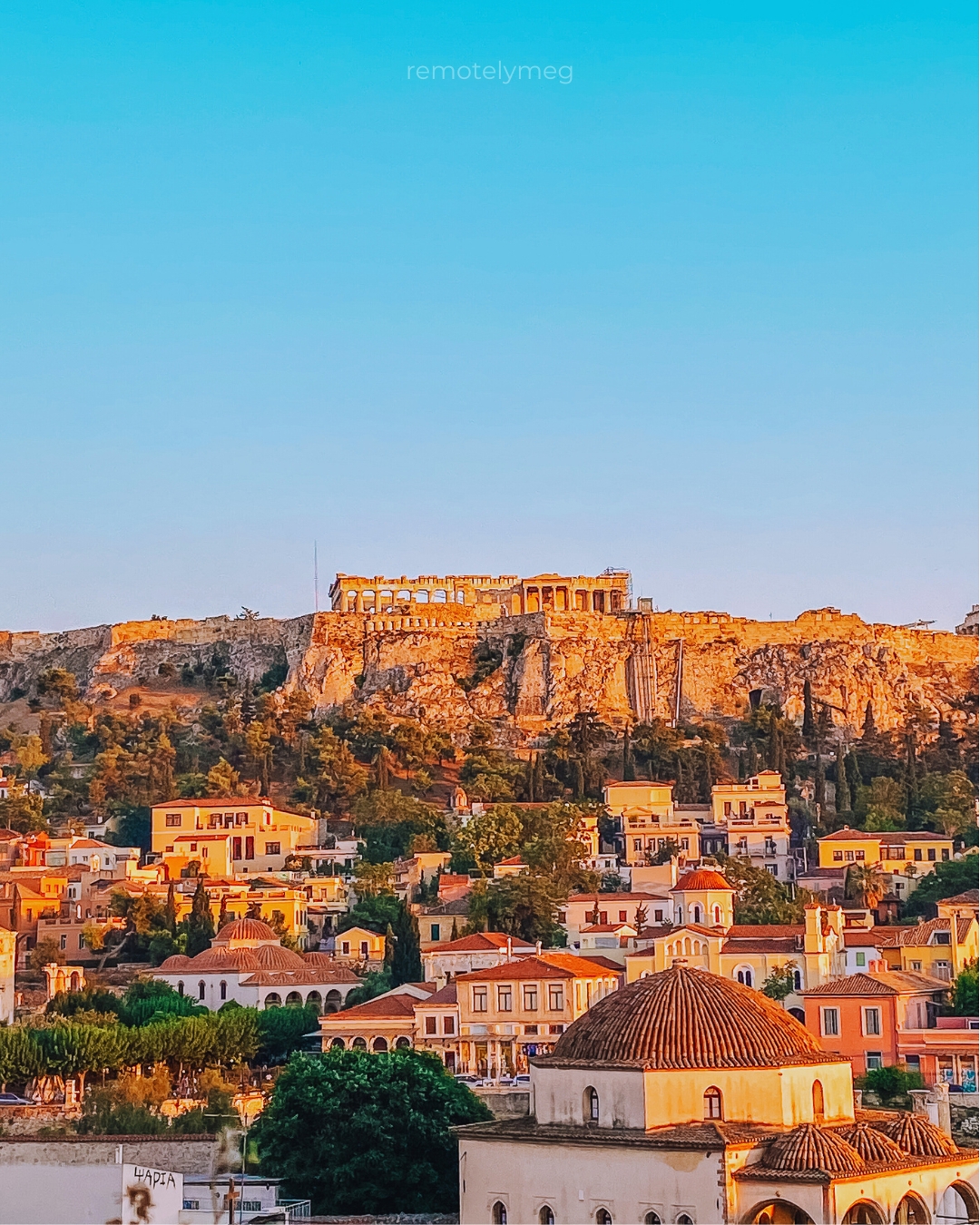
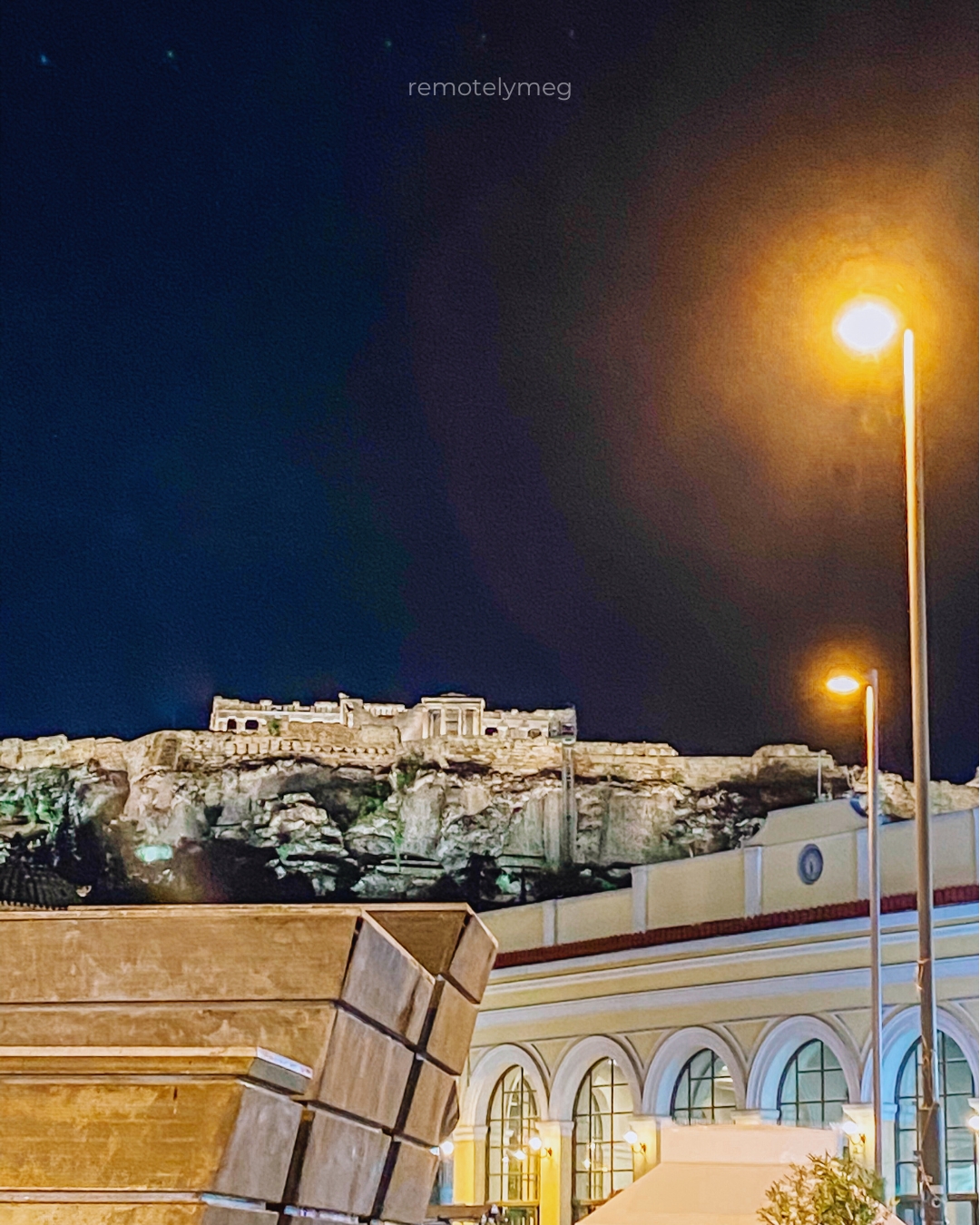
TOP TIP: Remember to see the Acropolis during all hours of the day as it’s equally magnificent in the daylight; when it shines golden at sunset; and when it’s beautifully lit up at night. If you’re exploring Plaka, Monistraki or Syntagma, you’ll definitely see it wherever you are – just look up to the hill!

Let me dive into a bit about each of these areas:
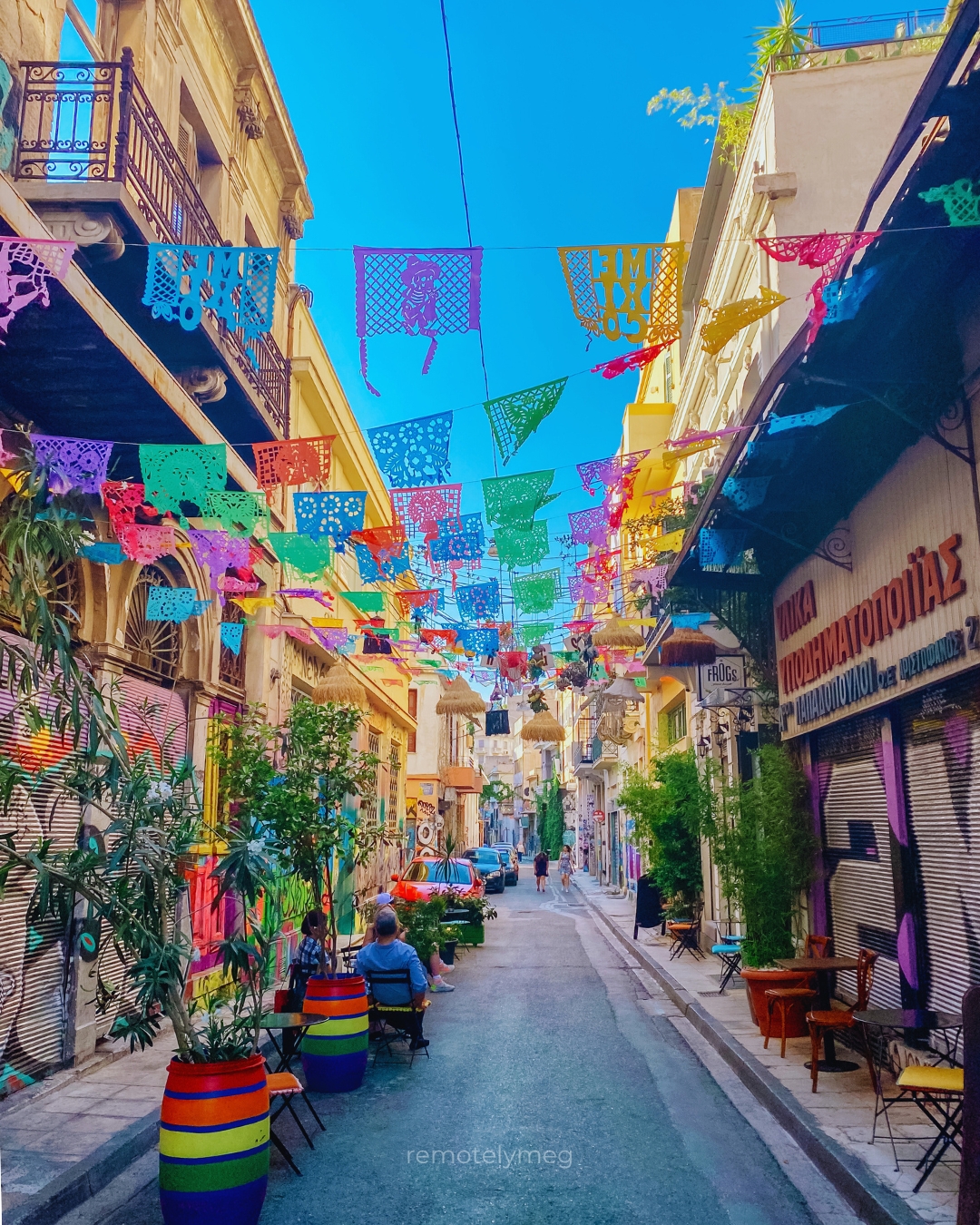
Plaka – the Oldest Neighbourhood in Athens, also known as “Neighbourhood of the Gods” as it sits below the Acropolis. This charming neighbourhood is full of neoclassic architecture and ruins, and is a maze of winding narrow streets, shops and traditional tavernas, and leads to Syntagma Square.
Monastiraki – Another neighbourhood amongst the oldest and most historic in Western culture is Monastiraki. Situated under the Acropolis, this charming, historic district is known for its buzzy Monastiraki Square, and shopping at major retailers on Ermou Street. Wandering through this neighbourhood you’ll find antiques, clothes, jewelry, and local handicrafts.
In this market you will find the perfect blend of historical eras, architecture and cultures, with roads branching off into every direction. I encourage you to take some time in this area, stand in the square, take in the energy of a summer’s evening in Athens, enjoy a cocktail on the rooftops and watch the Acropolis turn from gold to purple as the sun sets, then venture down the many different streets as they come alive at night with traditional music playing around every corner. Don’t forget to look up once more and enjoy the sight of the Acropolis lit up at night – it really does take your breath away.
Follow the famous Ermou Street that runs from Monastiraki Square all the way up to Syntagma Square, and is famous for its many shopping outlets along the street.
Syntagma – Syntagma borders the National Garden and is the political and economic hub of Athens. Syntagma Square is the most important square of modern Athens from both a historical and social standpoint, as it is the heart of commercial activity and Greek politics. Here you’ll find the Hellenic Parliament Building, which was once the Old Royal Palace, as well as the Tomb of the Unknown Soldier, and the iconic changing of the Evzones guards in their traditional uniforms. Syntagma Square is surrounded by shops, cafes, and some of the most luxurious hotels in Athens.
Syntagma Square is also home to one of Greece’s busiest transport hubs, where a multitude of bus stops and tram terminals converge at the underground metro station located just beneath the square.
Psirri – If you’re looking for the nightlight of Athens, you’ll find it here in Psirri – the ultimate nightlife district. This area is a charming mix of old and new, and is the entertainment centre for many young travellers. By day you can roam the area admiring the street art and galleries, and in the evening, these artistic streets come alive with music, food and people.
Kolonaki – Kolonaki neighbourhood is amongst one of the most upscale and wealthy in central Athens, with high-end boutiques, chic cafes, fine dining restaurants and trendy bars. It is often regarded as one of the most affluent neighbourhoods in Athens and offers both a fashionable shopping experience, and stylish nightlife options.
Colonus – An affordable, quiet neighbourhood outside of the bustling centre. While Colonus is not as well-known as other neighbourhoods in Athens, its historical significance and residential character make it an interesting part of the city to explore. Because of its association with Sophocles, visitors interested in ancient Greek history and literature may find it of particular interest.
This is where we chose to stay. We were happy with this choice as we were remote working so we needed a quieter spot. To our delight it was a peaceful neighbourhood with parks to walk around, but still accessible to the centre by a quick 6 minute bus ride.
Gazi – Once the old gasworks factory, Gazi neighbourhood has transformed into a trendy area, now known for its nightlife and entertainment venues. Here you will find many bars, clubs, live music venues, and contemporary art galleries.
Peristeri – Situated outside of the lively city but accessible by the city metro, this neighbourhood is known for its residential character and vibrant community. It is home to several cultural and sports facilities, including football stadiums, basketball halls and concert venues.
Piraeus – Just outside of Athens you’ll find Piraeus – the harbour of Athens. If you plan on catching any ferries to the Greek islands this is where you will find them.
But besides the ferry port, Piraeus is a bustling area with maritime character, featuring a vibrant waterfront promenade and many seafood restaurants and cocktail bars along the harbour to enjoy.
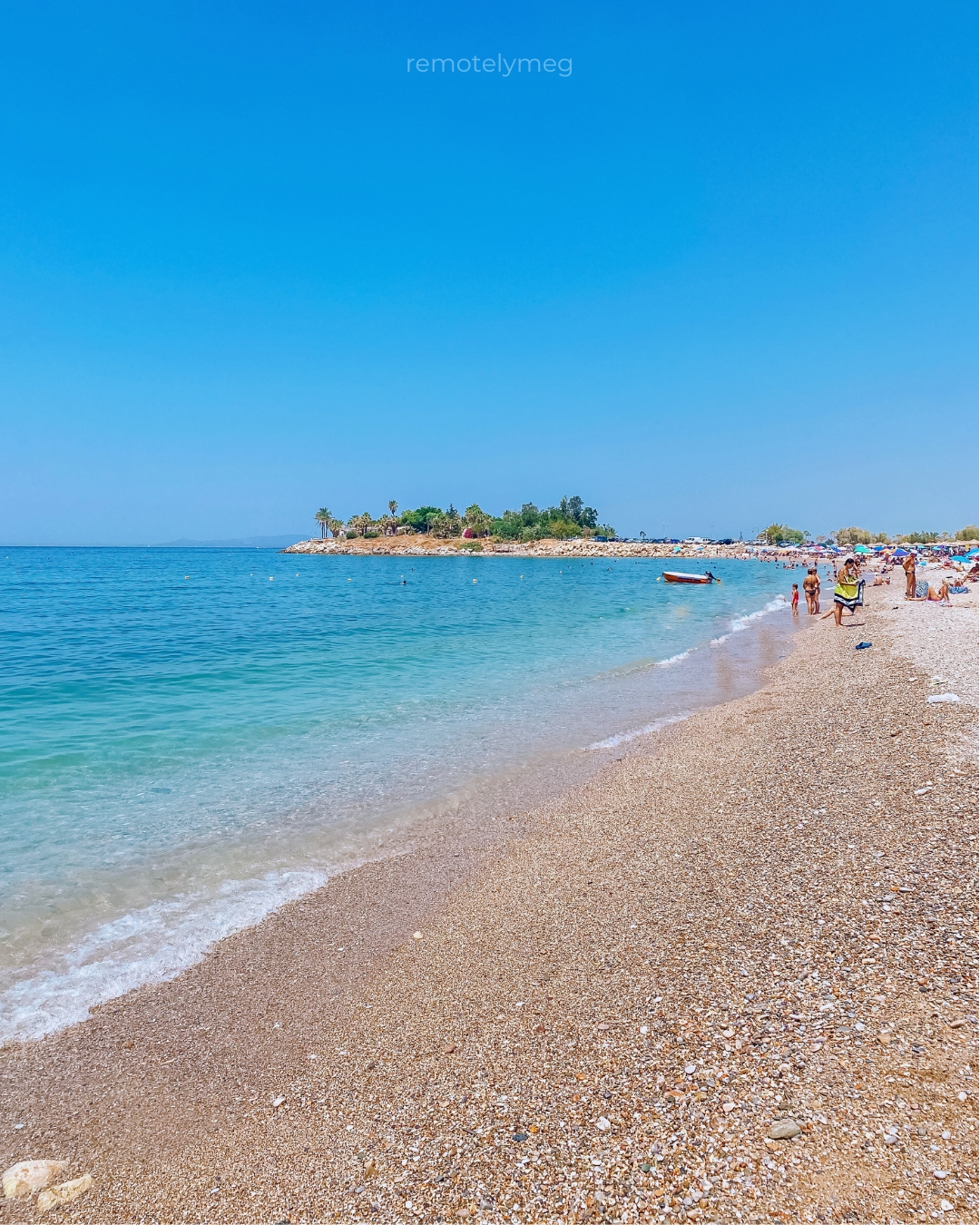
Athens Riviera – The Athens Riviera stretches along the coastline of the southern suburbs of Athens, from the neighbourhood of Piraeus to the Cape of Sounion. Its beautiful beaches, seaside resorts, and recreational activities make it a popular destination for both locals and tourists.
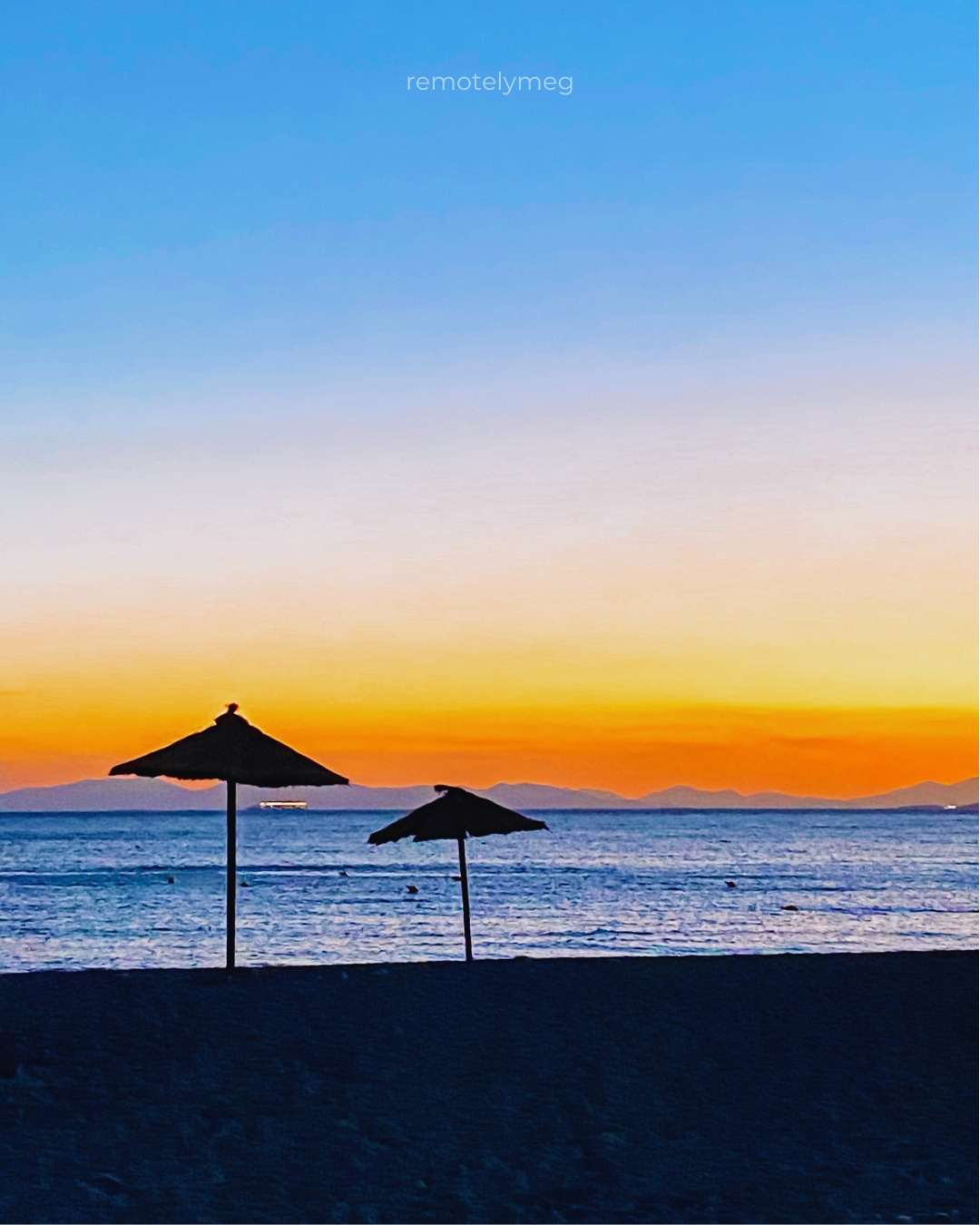
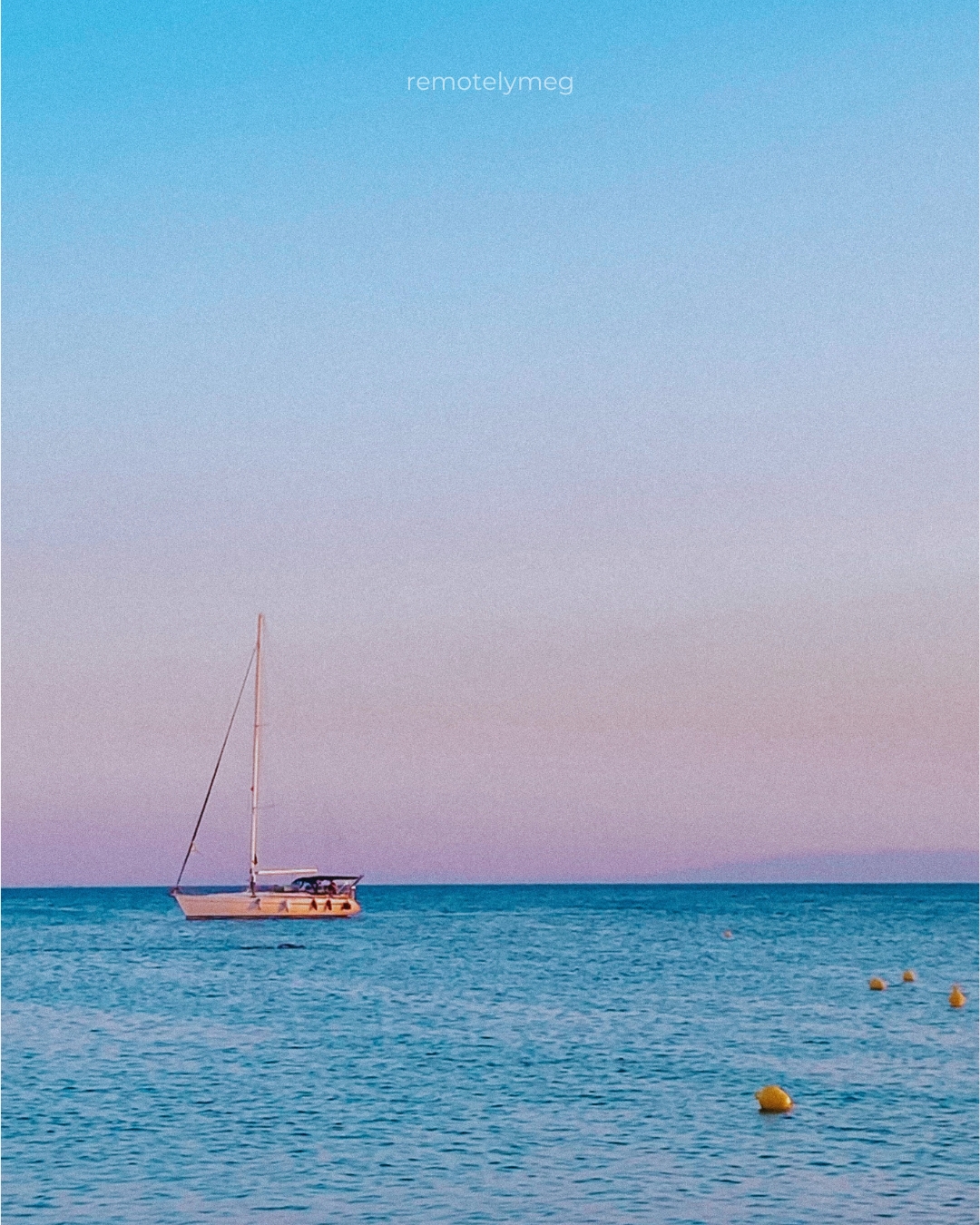
We chose to stay in Glyfada for two weeks as we wanted to be closer to the beach during our time in Athens. It was exactly what we were hoping for – vibrant summer sunsets over the Med looking out onto the Greek islands. We were able to spend all day in the sun and crystal-clear turquoise waters, and at night we took a bus down to the waterfront and found some vibrant beach bars.

Where to stay in Athens:
It all depends on what you want out of your stay.
Do you want to be in the centre of it all or do you want peace and quiet?
Two things determine where to stay: Price and Accessibility. These go hand-in-hand. The most ‘accessible’ and ‘touristy’ – the higher the price.
If you have limited time in this beautiful city, I’d suggest staying closer to the centre so you don’t have to worry about the bus system, however if you like to sleep with no noise – the quieter outside areas might be more for you.
Syntagma and Kolonaki you’ll find your more luxurious hotels. Syntagma will be closest to most of your destinations.
Plaka, Monistaraki and Psirri you’ll find lovely hotels, flats and backpackers right in the centre of it all – however these might be the noisiest areas.
Colonus – peaceful and less expensive, but you will have to catch buses to most of your destinations.
Gazi might be the cheapest area to stay.
I’d recommend looking on Airbnb and Booking.com for places to stay, and Hostelworld.co for backpacker options.
Here are some things you might want to look out for on Google Maps before you decide on a spot (especially if you are staying for a longer holiday / remote working)
- How close is the nearest supermarket / corner store?
- How close is the nearest bus station?
- Is it directly on a main road?
- Is it in an area near a park or monument?
- How close is it to the beach (if you are staying near the beach surrounding Athens)
These may seem obvious but here is why I find them so crucial:
Sometimes you don’t want to have to get on a bus or call a taxi just to head out and grab an essential food item you need for the day, so being near a grocery store is convenient.
A lengthy walk to the bus station after a long day of sightseeing and walking around town, or a long walk home after a night out in Athens will be better received (and safer) if you stay closer to a bus stop.
Main roads can be very busy and very noisy – so if you want peace and quiet, avoid staying too close to them.
I like to see a bit of nature during my day, and I love a safe space to run. This is more important for me when I remote work because often if it’s been a busy day I need to get out for at least an hour to be outside, and having a park or monument to walk around and enjoy is always best.
Just because you are staying in a beach town doesn’t mean you will be close to the beach. If you can, always check how many streets down from the beach you might be. Again, a long walk home after a full day at the beach (especially in mid-summer heat) could be harsh.

Highlights of Athens:
Now that you know the main areas, these are the main attractions that you’ll want to visit amongst those areas: Let’s start at the main attraction.
Acropolis: The Acropolis, which translates to “high city” in Greek, is a rocky outcrop that stands approximately 150 meters above the city of Athens, and once served as a sacred site and a fortified citadel in ancient times. It is one of the most important cultural and architectural sites in the Western world.
Situated on the Acropolis are several ancient structures.
Parthenon: The Parthenon is an ancient temple dedicated to the goddess Athena. Built in the 5th century BCE, it is considered a masterpiece of Classical Greek architecture, and was intended to be a symbol of the power and wealth of Athens.
Other significant structures on the Acropolis include the
Erechtheion – an ancient Greek temple built in the 5th century BCE, situated on the north side of the Acropolis. This temple is dedicated to multiple gods, including Athena Polias, Poseidon and Erechtheus, and is recognised for its historical and mythological significance.
Temple of Athena Nike – A temple dedicated to the goddess of victory, to offer thanks to the goddess for victories in war. The temple’s name, Nike, means “victory” in Greek.
Odeon of Herodes Atticus – an ancient Roman amphitheater located on the southern slope of the Acropolis. Built in the 2nd century CE, it is made of marble and has excellent acoustics, in fact, it is still used today for cultural events, such as concerts, plays, and dance performances.
Theatre of Dionysus – an ancient Greek theatre located at the base of the Acropolis hill. Dedicated to Dionysus, the god of wine and theatre, it is considered the birthplace of Greek drama and hosted classical Greek plays by famous playwrights like Aeschylus, Sophocles, and Euripides.
From the top of the Acropolis, you also get a breathtaking view of the city of Athens and the coastline.
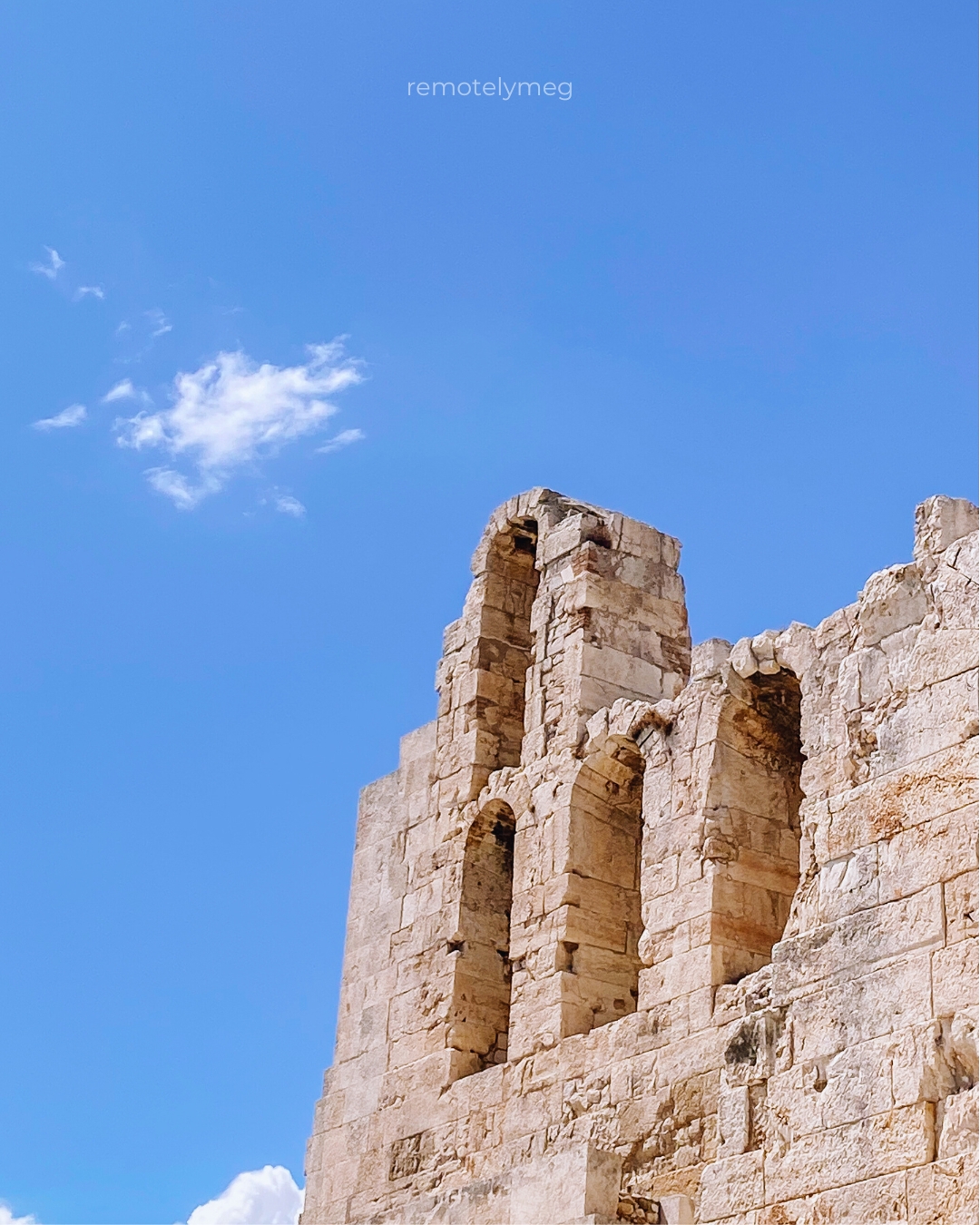

Just left of the Acropolis, you will find:
Ancient Agora: The Ancient Agora was the heart of the ancient city and served as a marketplace and gathering. Here you can explore the ruins and visit the Temple of Hephaestus.
Below the Acropolis you will find:
Temple of Olympian Zeus: This enormous temple was dedicated to Zeus and was one of the largest temples in ancient Greece. While it now lies in ruins, its massive columns and impressive scale will leave you in awe.
There are many other historical sites and ruins that can be found around Athens if you wish to see more, such as the Roman Agora, Hadrian’s Library, and the Panathenaic Stadium, which served as the venue for the first modern Olympic Games in 1896. The Temple of Poseidon lies at the end of the Athens Riviera, in Cape Sounion, along with the Temple of Athena Sounias.
If you wish to visit a few museums during your stay to better your understanding of Greek history, here are my top picks:
Acropolis Museum: Located near the Acropolis archaeological site, The Acropolis Museum is a modern museum built to safeguard and display the artifacts found on the Acropolis. This is a must-visit for anyone interested in ancient Greek civilization, as it provides valuable insights into the culture and art of ancient Athens.
National Archaeological Museum: While the Acropolis Museum delves into the specific significance of the Acropolis and its iconic structures, the National Archaeological Museum offers a broader perspective of Greek history.
This museum displays an extensive collection of ancient Greek artefacts, including sculptures, pottery, and jewellery from various archaeological sites all across Greece, such as Mycenae, Delphi, and Santorini.
Benaki Museum: The National Archaeological Museum focuses specifically on ancient Greek civilisation and its archaeological treasures, the Benaki Museum focuses more on Greek art and history from different periods, ranging from prehistoric times to the modern era. It offers a diverse collection of paintings, sculptures, textiles, and historical artefacts.
If you’re looking for experiences, these are my must-see areas of Athens:
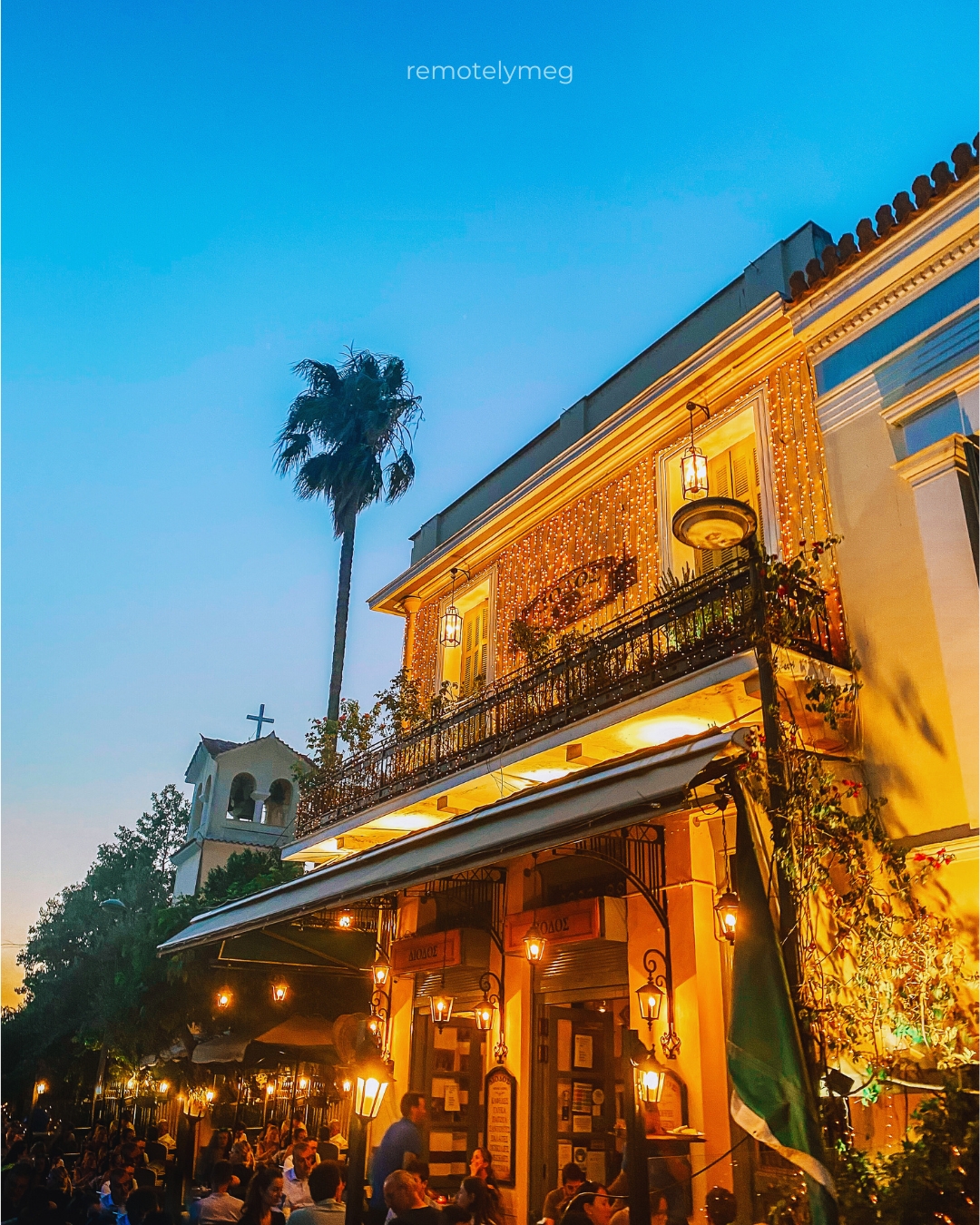
Plaka: This charming neighbourhood right below the Acropolis is famous for its narrow winding streets, lined with neoclassical buildings, colourful bougainvilleas, and traditional tavernas. Plaka offers cozy outdoor seating areas where you can enjoy a cup of Greek coffee and many traditional dishes. Spend a few hours getting lost in the winding streets, admiring all the different avenues dotted with souvenir shops of traditional handicrafts, jewellery, and local products.
Plaka is also home to Athens and Europe’s oldest street – Tripodon street, which has kept its name for almost 25 centuries, and holds a place in the Guinness World Records. Put this on your bucketlist to visit as it’s another incredible piece of history that Athens has to offer.
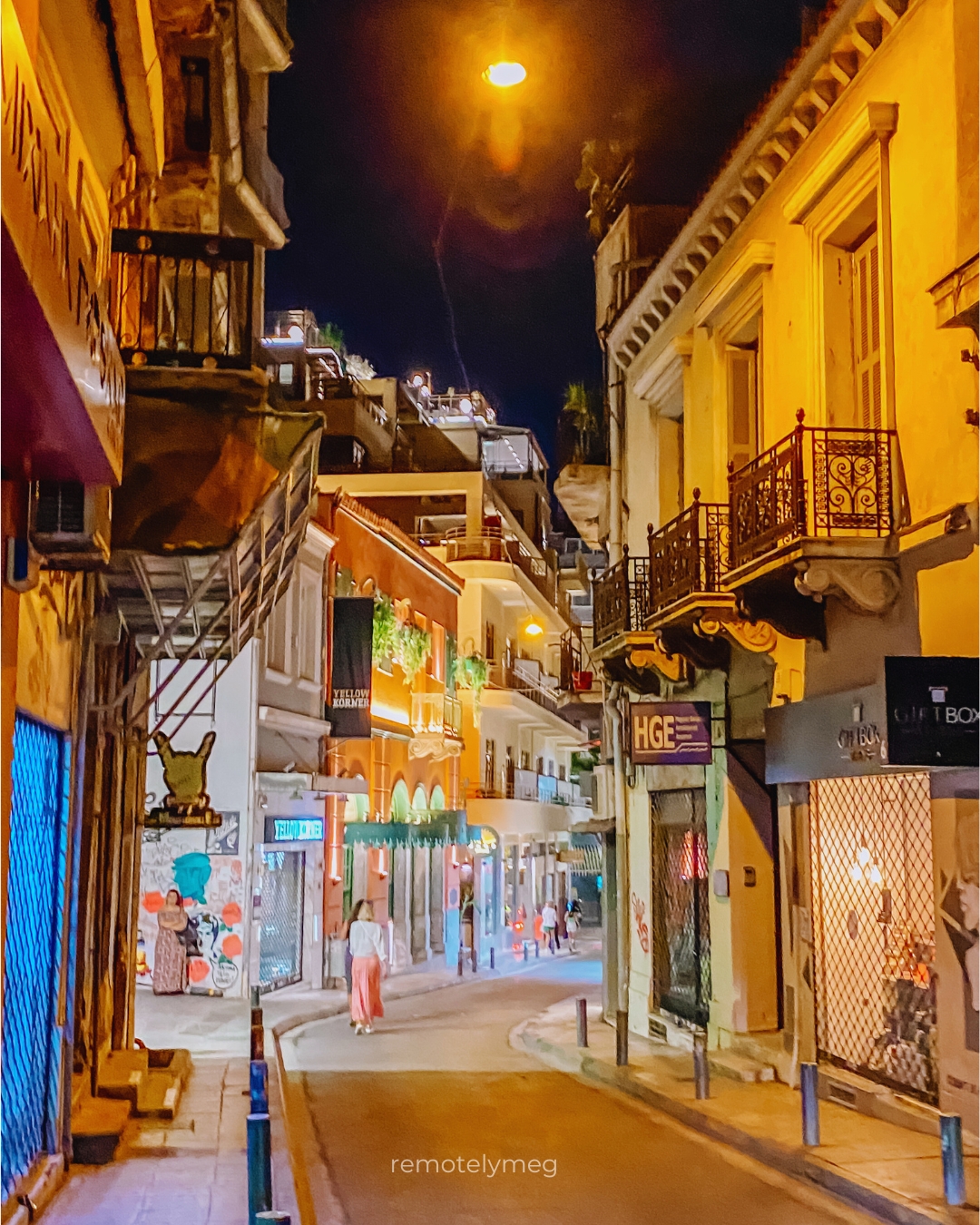
Psirri: Some of my most memorable nights in Athens were spent wandering these streets admiring the art and listening to live Greek music. Later in the evening we would venture into one of the many cocktail bars or clubs in the area and dance into the early hours of the morning.
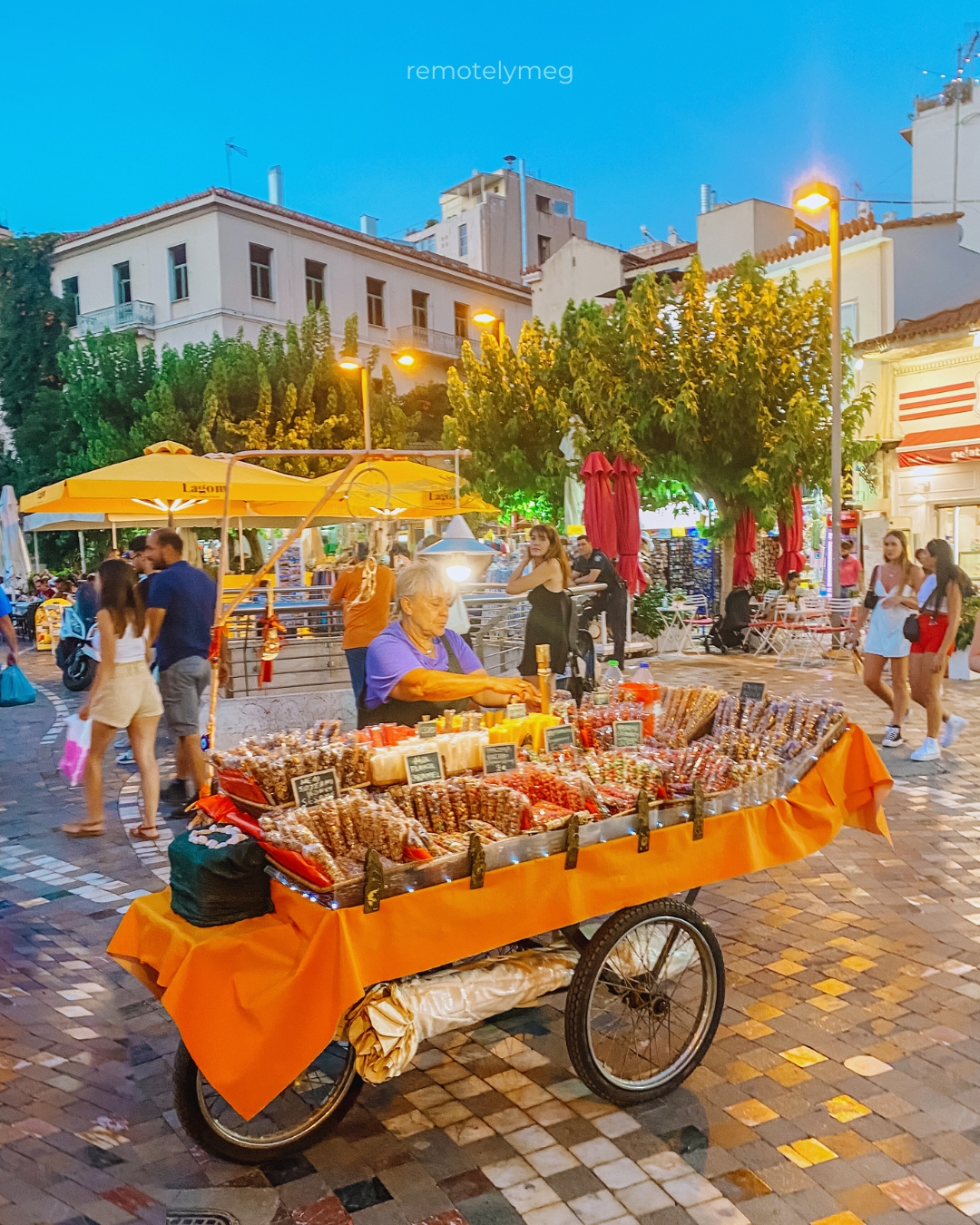
Monastiraki Square: This is the market where Greece gathers, and it buzzes with optimistic street vendors, excited children, local families sharing stories and awed tourists trying to take it all in. Looking up on the hill you’ll see the Acropolis – beaming in gold as the sun sets for the day. To the left lies the Tzistarakis Mosque, and scattered around the square are busy restaurants proudly serving Greek cuisine. Up on the other side are the modern buildings, each with their own rooftop bars boasting their uninterrupted views of the Acropolis.
Syntagma Square: As mentioned above, start at Monastiraki Square and follow the famous Ermou Street all the way up to Syntagma Square, and admire all the shopping outlets this street is famous for. When you reach Syntagma Square, walk past the water feature and up the stairs to admire the Hellenic Parliament building.
At the Hellenic Parliament building you’ll also find the Tomb of the Unknown Soldier, which is a memorial site for all the unidentified fallen soldiers who made the ultimate sacrifice defending their country. It is a symbol of respect and remembrance.
The Tomb of the Unknown Soldier is guarded by the Evzones, who are members of an elite unit of the Greek Presidential Guard. The Changing of the Guard Ceremony is a popular event that takes place every hour in front of the Tomb. The ceremony involves precision, tradition, discipline and honour, and is a humbling ceremony to watch. As I said earlier, we must pay respects to those who put their lives on the line to protect the people and landmarks of the area you are lucky enough to be experiencing.

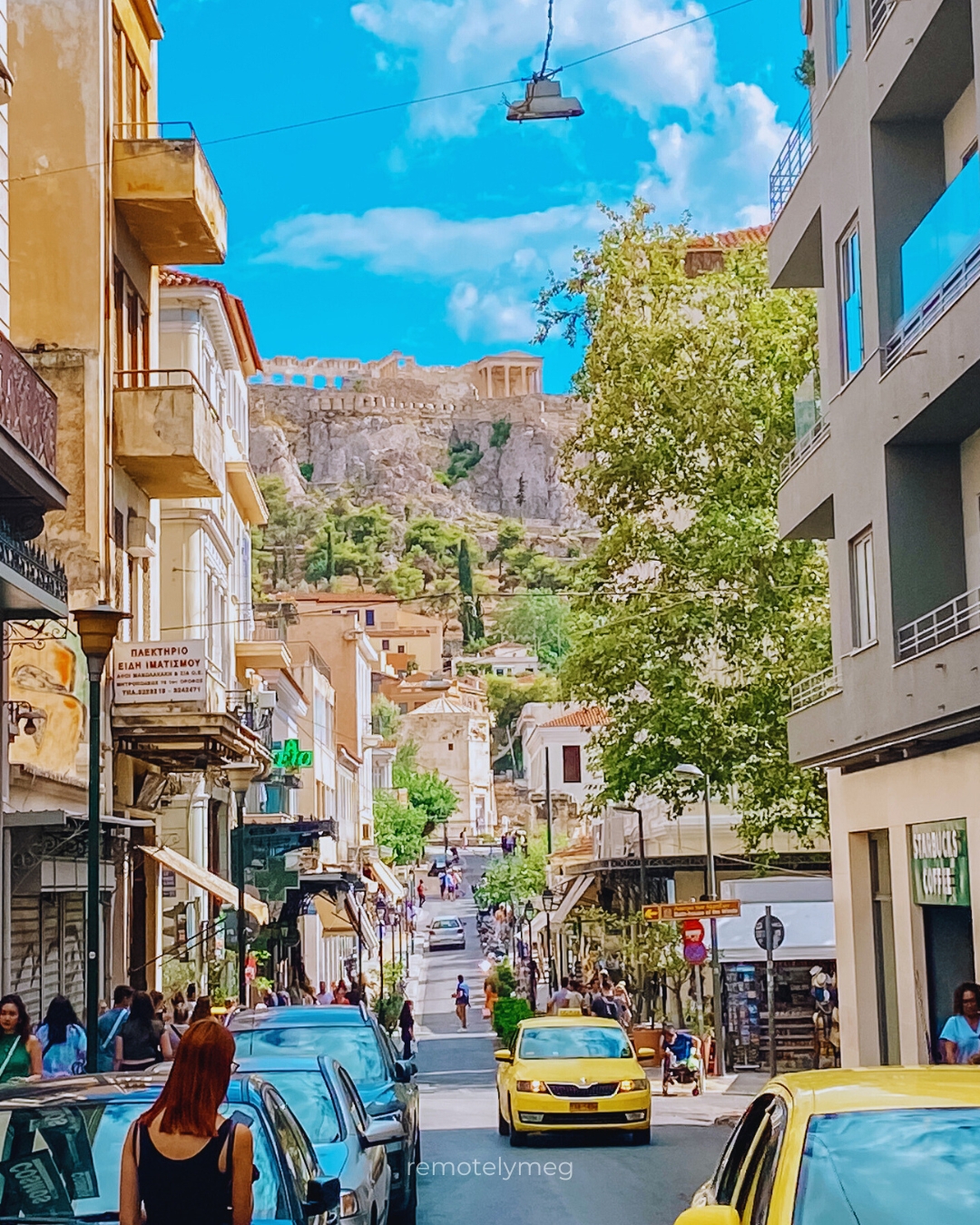
The National Gardens: Also known as the Royal Gardens as it was initially part of the Royal Palace complex and was later transformed into a public park, is located just behind the Hellenic Parliament building, adjacent to Syntagma Square. The garden provides a peaceful retreat from the bustling city and one can find many botanical delights and historic monuments inside while exploring it’s many winding paths.
Piraeus (in the day or night): We loved going to Piraeus to watch the sunset and have a few cocktails as we explored the harbour, and we especially enjoyed walking the strip of super yachts just in front of Papanikoli Square.
Athens Riviera (day or sunset): If you are staying in Athens and just want to get to the beach for the day, you can take a train from Athens – Piraeus – Glyfada, and stop along the coastline to find some incredible beach clubs to spend your day and stay to watch the sunset over the Greek Islands in the distance.
If you’re looking for views of Athens, or maybe a bit of a green escape from the lively city, here are some key places to visit:
Mount Lycabettus: Mount Lycabettus offers panoramic views of Athens. You can hike up or take a funicular railway to the top, and here you’ll find a small chapel and fantastic restaurants for coffee and a snack as you admire the view.
Areopagus Hill: Areopagus Hill is located to the west of the Acropolis on a rocky outcrop. In ancient times, it served as the meeting point of the Areopagus, a council of elders who dealt with matters of justice and governance in Athens. Here you can see the remains of a marble staircase that led to the council chamber, and a plaque commemorating the Apostle Paul’s speech.
You can walk up to this hill and admire the iconic Acropolis, the Parthenon, the Odeon of Herodes Atticus, and the Theatre of Dionysus, and take in the view of Athens below.
Filopappou Hill: Southwest of the Acropolis lies the Filopappou Hill, which offers a tranquil environment and provides remarkable views of Athens and its landmarks. Don’t forget to look out for ancient ruins on the walk up.
Getting around Athens:
The public transport in and surrounding Athens is terrific and reliable.
Because we were there for a month we got monthly cards for 40 Euros which had unlimited uses (including airport trips).
The bus routes are hard to wrap your head around at first, however, Google Maps does an amazing job at helping you navigate bus routes. Just type in where you want to go, and use the bus option, and it will show you everything you need. It even tells you when your bus is arriving and when to get off the bus at your stop. This honestly was a lifesaver and saved me many moments of panic, so thank you Google Map!.
The one and only problem with public transport is when it comes to the early hours of the morning. Some buses still run, however they are less frequent (usually only once an hour) so check your bus schedule beforehand. The specific route you take might not run late and you’ll have to find another route passing your way. If you are really stuck – be safe and get a Beat (Athens Uber equivalent).
Another thing you should know – buses run less frequently on a Sunday too – so check the schedule the day before so you can plan when to leave and not waste an hour of sightseeing waiting for a bus.
Personally I didn’t feel the need to rent a car as the public transport was so convenient and affordable – especially if you are planning on staying just in Athens and then heading out to one of the islands.
Obviously the beauty of a car is to go wherever you want whenever you want, but from my experience you can get everywhere you need on the bus or train.
The downside of a car is constantly having to find parking spaces, and the added expense of renting a car, paying for insurance, filling up with petrol, and reading road signs in a different language (and alphabet!).
However, I can acknowledge that if you are travelling as a big family with small children or many passengers, renting a car may be more affordable and convenient. It’s your vacation so you do what makes you happiest and most relaxed.
From the Airport into Athens:
A taxi into Athens should be around 60 Euros depending where you go, and because we had just arrived and didn’t know any better, we took a taxi. It was a hard learning curve for us when we discovered the next day that we could have taken the train for 13 Euros. (I spent my money so you don’t have to – learn from my mistakes).
If you have time and want to save money – the city metro has a route from the airport into Athens, where you can connect to another bus that will take you to the area where you are staying.
Overcharged taxi fees can be the quickest way to put a damper on the holiday as you arrive, so agree on a price with your driver before or use the Beat Ride App (Greece’s Uber) to know your price up front.
Apps to use:
Apps to use:
- Beat Drivers (equivalent to Bolt and Uber)
- Google Maps – Download Google Maps of Athens and have accessibility to it even if you have no data/WiFi! This was a serious life saver for us.
- Google Translate – Google Translate using your camera. This was amazing as Greek is an entirely different alphabet, so this was great for translating road signs and menus.
- SIM cards – There are sim card stalls all over Athens, however, I found an E-SIM app that instantly downloaded an E-SIM onto your phone without the hassle of finding a store, swapping sim cards and it can be topped up online without having to find a store. A note to be careful of simcard scams in Athens. Always buy from an official store.
Remote Working in Athens:
There is a hub of remote workers flocking to Athens during the summer, and I’m not surprised why. With so much to offer in the city – art, history, nightlife, traditional cuisines and quick access to all the Greek Islands for weekend trips, and being a more affordable Mediterranean destination than other countries nearby, it’s a remote workers hotspot for good reason.
You’ll find many remote workspaces in Athens that you can rent out for the day / week or even month, and this is a great place to meet remote workers like yourself.
The WiFi in Athens is generally strong for working and we never had a problem, however, if you are worried and rely on strong WiFi – ask your hotel / host to verify the WiFi upload and download speed before you book.


My Honest Review:
Athens was a great starting point to understand and appreciate the history of Greece before moving on to the Greek Islands. This being said, I think it would be a shame to be in Greece and not visit some of the incredible islands on offer. I visited four islands during my three months in Greece (Mykonos, Naxos, Corfu and Paxos) – each with their own charm, adventure and unique culture. I loved the Greek Islands so much that I’m already planning my return to explore more. So please don’t visit Greece without seeing some of the islands. You can see my other blogs for my Honest Reviews of each, as well as some advice on the Ionian Islands vs Aegean Islands.
Even before visiting I was drawn to the culture, architecture and history of Greece, but during my time in Athens and the Greek Islands, my love (obsession) for Greece grew very quickly. The historical sites, ancient ruins, traditional food, local beers and cheery music – and not to mention the hospitable locals – all made my experience in Greece like none other. I can honestly say, Greek hospitality is hard to compare to. I felt so welcomed and invited everywhere I travelled, which is always better than feeling unwanted in a new country.
Greece is one of the more affordable Mediterranean destinations which appealed to me since I was spending 3 months travelling, and honestly I managed to stay well within my budget. However that is because I was conscious not to live like I was on constant vacation, as hard as it was, and cooked most meals at home or packed lunches for a day out. Food and drinks will drain your bank account very quickly, so I’d treat myself to meals out only a few times a week.
Honestly, I loved Athens, and I’d return to Athens, or any Greek Island, faster than I would to any other country I’ve visited in Europe so far. I was fascinated by the history of Athens, and love being able to roam the ancient ruins and admire the ancient temples, and then spend the evening wandering the vibrant streets, eating local cuisine and enjoying the clubs to the early hours of the morning. So if Athens wasn’t on it already, add it to your bucketlist!
Read My Honest Reviews of the other Greek Islands here.


 remotelymeg